

Paul Andrews produced a remarkable number of quality games for the Amiga during the early to mid-1990s, and the crazy part is that I genuinely loved most, if not all, of them. He had a reputation for using Blitz Basic, and before you run away at the mention of it, we're talking about the developer behind titles such as Seek and Destroy (review coming soon), Overkill, and Roadkill, a game that enjoys something of a cult following today. Woody's World, however, is one of the more overlooked games in his catalogue, which is quite surprising because it is also one of the better platformers available on the Amiga. Somehow, despite its quality, it rarely gets mentioned when people discuss the system's standout platform games. That is exactly why this article is part of my The Games We Not Talk About (But Should) series. Like so many of the titles featured in this series, Woody's World is a game that deserves far more attention than it gets. Give it a proper chance and I think you'll be pleasantly surprised by just how good it actually is.


The World Of Wonder b… Umm Woody…
The first thing you'll notice about Woody's World is how good it looks and feels. While there are not that many upgrades beyond extra health, new costumes, and the occasional power-up, the game still reminds me quite a bit of James Pond 2: Robocod. Mix that with some elements from platformers like Mario and Sonic, and you'll have a pretty good idea of what to expect.
The game is packed with secret locations, most of which can only be reached by discovering hidden platforms, making tricky jumps, or navigating your way over countless traps. Exploration is heavily rewarded, and there is always the feeling that another hidden area is waiting just out of sight.
Your objective is to collect all of the chests scattered throughout the game's often massive levels (but, only 50% of them is needed to unlock the next level). There are around twenty worlds to explore, each containing three large stages. Every world features its own visual theme, or builds upon the style of the one before it, helping to keep the adventure feeling fresh as you progress.
All of the worlds are interconnected, and while there are no map screen ingame to help you find your way around, navigating the game is not nearly as straightforward as it first appears. The maps are larger and more complex than expected, which only adds to the sense of discovery and adventure that makes Woody's World such an enjoyable platformer.


 Bonus Levels, Nice Hardware Trickery...
Every now and then you'll come across a bonus stage, and some of them are surprisingly original. A few feel like they could have been lifted straight out of James Pond 2: Robocod, while others introduce brand-new ideas and gameplay twists. Some of the more memorable ones have you moving at ridiculous speeds, pulling off insane jumps (you need an upgrade for that move), and relying on a fair amount of skill and precision to make it through in one piece.
Just like the main game, these bonus levels come with the added pressure of limited lives. Thankfully, extra lives are fairly common throughout the adventure, so running out is rarely a major problem. What is a problem, at least in my opinion, is the ever-present timer.
I have never been a fan of timers in platform games. I just want to relax, explore, and enjoy the levels at my own pace, and Woody's World is exactly the kind of game that encourages that style of play. With all its secrets, hidden routes, and collectibles, it feels like a game that would benefit from letting players take their time. Instead, the timer is always there, pushing you onwards whether you like it or not. It is not a dealbreaker by any means, but it is one of those design choices that always feels more frustrating than necessary.


Awesome Presentation Across The Board...
Woody's World is not without its shortcomings. It could definitely have benefited from a few big boss battles or other major set pieces to break up the gameplay. Another thing most players will probably notice is the relatively low enemy count. There are only a handful of enemies in each level, and they are often spread far apart rather than appearing in large groups.
The reason for this quickly becomes apparent when you look at what the game is doing technically. The levels are absolutely huge, packed with colourful graphics and supported by incredibly smooth multi-layered eight-way scrolling. The game also features moving platforms, rotating Mode 7-style platform sections, and plenty of visual effects that help bring the world to life. On top of that, it manages to play music and sound effects simultaneously without compromising the experience.
What makes all of this even more impressive is that Woody's World runs on a standard Amiga 500 without requiring any memory expansions (box says 1mb but it runs fine with less). That is quite uncommon for a game of this size and scope, as many similarly ambitious titles require at least ECS, additional Chip RAM, Fast RAM, or a combination of both to achieve comparable results.
When you look at the complete package, it becomes easier to understand why some compromises had to be made. The lower enemy count may disappoint players looking for constant action, but in exchange you get massive levels, fluid scrolling, impressive visual effects, and a technical showcase that pushes the humble Amiga 500 surprisingly hard.


Woodys World Box...
My copy of Woody's World is looking a little rough these days, but that's hardly surprising. It uses one of those slipcase box designs where the fit is just a bit too tight, and after more than 30 years of being taken on and off the shelf, the wear is definitely starting to show. I've even had to use a bit of transparent tape here and there to keep the box together, which is never ideal, but sometimes you have to do what you can to preserve a favourite game.
Some of you may have noticed that Woody's World was not published by Acid Software or Mindscape, unlike many of Paul Andrews' other titles. Instead, it was released by Kompart, and that may well be one of the reasons why the game ended up being relatively rare. By this point, Kompart had largely become a secondary publishing and distribution label for Richard Holmes' Black Legend Software before more or less disappearing from the scene altogether. Aside from publishing The Clue in certain regions the following year, they never really established themselves as a major Amiga publisher.
If I ever come across a sealed or mint-condition copy of Woody's World, I will happily buy it all over again. In fact, I purchased another copy around six years ago hoping for an upgrade, only to discover that it was actually in worse condition than my original one. Rather than keeping it, I sold it to my friend in Sweden. So, if you're reading this, hello Kjell Breding! At least it found a good home in the end.
Slim Findings But Still Worth It...
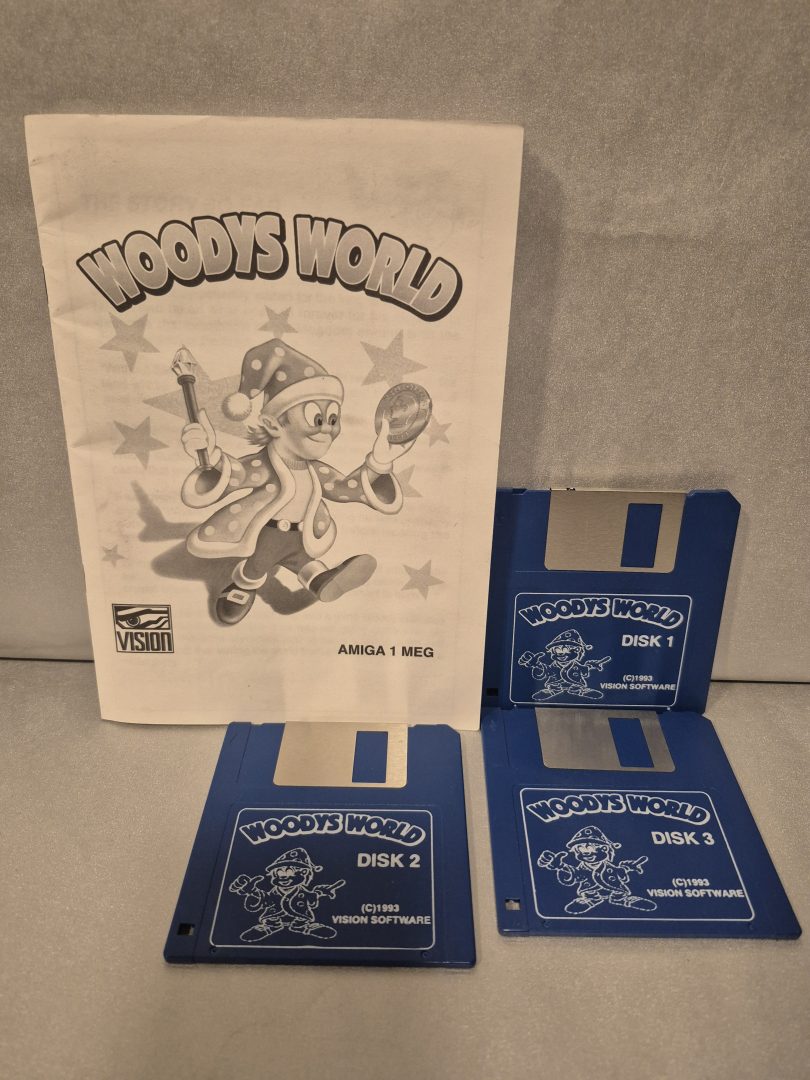
Woody's World comes in a traditional big box, but the contents are about as bare-bones as they come. Inside you'll find a manual and the three floppy disks that make up the game, which is really all you need. Interestingly, I seem to remember that the pirate version was spread across four disks, though I could be mistaken on that one.
One thing that has always stood out to me is the artwork used on the floppy disk labels. It looks completely different from both the cover art and the illustrations found in the manual. In fact, it is so different that I've often wondered if it was originally created for an entirely different game and simply reused here.
The strange thing is that it looks incredibly familiar. Every time I see it, I get the feeling that I've seen the character or artwork somewhere else before, but I can never quite remember where (could it be from the Pang cutscenes?). Maybe it's from another Amiga game, maybe a console title, or perhaps I'm just imagining it. Either way, it feels oddly disconnected from the rest of Woody's World's visual style, making it one of those little mysteries that has been nagging at me for years.

Summary...
Woody's World is one of those games that I genuinely think you should give a chance. It is both original and fun, especially when viewed in the context of the Amiga platform and its era. It may not have the technical wizardry of games such as Kid Chaos, Mr Nutz or Brian the Lion, but it does enough things differently to stand out from the crowd.
The learning curve can be a little rough at first, particularly when it comes to mastering the super jumps, understanding where to find upgrades and what they do, and learning how to move through the levels efficiently. Once everything clicks, however, the game becomes far more enjoyable and many of the frustrations simply fade away.
Another feature worth mentioning is the level code system. This means you do not have to complete the game in a single sitting, which is a huge bonus considering the size of the adventure and the amount of exploration involved.
Overall, Woody's World is a quality title that sadly flew under the radar for many Amiga owners. My suspicion is that it did not sell particularly well, and the fact that even used copies can be incredibly difficult to find these days certainly seems to support that theory. That is a real shame, because Vision Software produced a surprising number of quality games over the years, games that arguably deserved a much larger audience than they received.
 If you are tired of hearing about the same handful of Amiga classics over and over again and want to discover something a little different, Woody's World is exactly the sort of hidden gem you should be looking for. I agree with Amiga Computing and CU Amiga, this is a 9 out of 10 game.
Screenshots courtesy of Hall of Light. GIFs and box photos by me.
I played this quite a bit when it was new. I remember really enjoying it and always wanted to get back to it one day (35-ish years later its still on the to-do list).
ReplyDeleteI cant remember it too clearly, but I seem to recall it being fairly simple and staightforward, but there was something about it that made it more fun than the sum of it's parts. The sort of game that is always more fun to actually play than a person remembers when thinking back on playing it.
Yeah it is pretty straightforward indeed, but i still love it.
ReplyDelete